Showing posts with label Tokyo. Show all posts

Friday, April 9, 2010

Northern Japan #6: Edo-Tokyo


Late August 2009

(Friday, Saturday morning)

Last time I came to Tokyo, there were times people gathered so thick around me, I felt like I was no longer walking but getting swept away by a slow-trudging river. Even at its best, Tokyo was a city where you couldn’t escape people. A walk in the park meant tripping over picnickers; breakfast at a temple was shared with a film crew.

But this time it was different. I caught the 8:45 train on the Yamanote loop from Ueno to Akihabara on a Friday morning. By all logic I should have been crushed like a soda can in a trash compressor. Instead, no one even touched me.

Obon probably had something to do with it. The tradition of returning home to pay respects to the ancestors is the one genuine excuse the Japanese have to travel. Then again, it might have been the places I chose to visit: Iriya, Ebisu, and Ryogoku aren’t exactly popular. Whatever the reason, Tokyo didn’t feel as crowded as I’d remembered.


Long colorful paintings of sumo wrestlers met me at my stop. The Sumo Stadium was somewhere nearby, but I drifted along to the Edo-Tokyo Museum. My guidebook called the massive building structure impressive; I called it ugly. The bottom part of the museum was hollowed out—groups met under the shade and waited for their guides to buy tickets—while the roof was bulky, containing most of the exhibits. I wondered that the roof didn’t simply squash us flat. Grass or trees might have softened the effect, but there was nothing but concrete around the area.

The Edo-Tokyo museum was my entire reason for coming. A month earlier, two phone calls and a fax had secured me an English-speaking guide. I met him on the sixth floor in front of the permanent exhibition. He was an older Japanese man with slightly longish grey hair. I asked his name and he told me to call him “Simon.”

“If you’re Simon, then you can call me Isako,” I said, jokingly. From the very beginning, he and I got along wonderfully.


A giant bridge, a replica of the Nihonbashi, split the permanent exhibition in half: Edo to the left, Tokyo to the right. (Just so you know, Edo and Tokyo are both names for the same city; it was called Edo from 1600-1868 and Tokyo from1868 on out.) The room was dimly lit, but I could see the various life-sized buildings and artifacts scattered just below the bridge. Most impressive was the kabuki theatre and newspaper building.

On a normal day, I think Simon would explain the basic history of the two eras, but I already knew that, so we just leaned against the railing of the bridge and chatted. I told him I was from Kagoshima Prefecture and that I liked to study about the Bakumatsu period (1853-1868) in Japanese history.

“You probably know more about it than I do,” he said.

The Edo-Tokyo museum focused on the Edo era (1600-1853) and skipped over my favorite era completely. This didn’t really surprise me. It didn’t bother me either, because the actual lifestyle of the people in the Bakumatsu era was almost identical to that of the Edo era. Except with more violence.


We eventually walked off the bridge and came to a life-sized replica of a palanquin. Simon urged me to get inside. The lacquered box was roomier inside than it looked. I could stretch my legs all the way out. While I was making myself comfortable Simon told me that this palanquin was used by the lords.

“You’ve probably heard of this word—‘alternate attendance.’ ”

I did. It was a system set up by the Tokugawa Shogunate wherein the lords, sometimes called daimyo, were required to make trips to Edo every other year. This trip drained them of their money and broke their ties to the land. A very clever system for to keep control of the daimyo and ensure the samurai didn’t rebel.

“How long do you think it took to come to Edo from Kagoshima?” Simon asked me.

“Four months?” I said.

“Maybe three or four months. As soon as the daimyo came to Edo, he had to start planning his trip back.”


We passed more traditional documents under glass. Simon showed me a picture of Edo burning and explained that in 1657 a great fire burned down 60% of the city. They had to rebuild, a common theme in the history of Tokyo. A crowd was gathered next to a chart of the Tokugawa lineage, but I had no interest, so we moved on.

We came to models of the aqueduct.

“The water went to wells,” Simon said. “Of course the samurai had their own well, but the townspeople had to share. They also shared toilets. But the waste from the toilets didn’t go underground. The farmers took it. They would come in the mornings with buckets of vegetables and leave with buckets of manure. It was useful for growing vegetables. Nothing wasted.”

I like to think of myself as fairly well-versed on Japanese history, but Simon made me look like an amateur. He told me about hazardous birthing practices, explained that bookstores didn’t sell books, and showed me a print of carpenters worshipping catfish as a symbol of earthquakes. I followed with my notebook open, a pencil in my hand, and eagerly scribbled notes.

We came to a display of gold coins—gold for Tokyo, although Osaka and Kyoto used silver. The big flat bars were used only by the Shogun. I pointed to the small coins with the hole in the middle, resembling a five-yen coin of today.

“Did people use those coins when they went shopping?” I asked.

No, Simon said. Most people didn’t actually go shopping. Vendors came to them, selling fish or tofu or renting out books. People knew each other face to face, and they didn’t exchange coins except once or twice a year. Credit was the preferred method. I thought this funny. Japan, the land of cash, using credit long ago.


Simon led me to a miniature of a long, impressive building with a black roof and no walls on the first floor. Faceless little people bustled in and sat on the tatami mat, looking at the displays of goods.

“Now this was a very successful store,” Simon said.

“What’s its name?” I asked.

“Mitsukoshi,” he said. “Do you know it?”

“It sounds vaguely familiar.”

“It’s still in Tokyo. Today it’s a department store.”

Mr. Mitsukoshi had been a very clever man, Simon explained. First of all, his enterprise was based in Kyoto, so he benefitted from the gold-silver exchange rate. The actual store, like Wal-mart, had everything. People from all ranks and classes could shop freely. But what made the store so revolutionary was its “cash only” policy. You see, those vendors working on credit occasionally had people who would take off when their bill was due. So, to insure they made money, they charged interest. But because Mitsukoshi only accepted cold, hard currency, it did away with the interest. It sold its products at rock bottom prices.

There was so much to see and soak in—but I won’t bore you any longer. There is only one more display I’d like to mention because it seemed to be of special interest to him. It was a simple map of the city of Tokyo during World War II. A press of the button and various sections of the city lit up.


“When we become a tour guide, they make us learn three dates,” Simon said. “1657—that’s the year of the fire. 1868—you know, the year of the Meiji Restoration. And March 3, 1945.”

“March 3rd?” I said. It didn’t sound familiar. “Why is that date important?”

“March 3rd,” he said, “was like our September 11th. That was the day the air raids fell hardest on Tokyo.”

For each area that had been bombed a portion of the map lit up. At first, it was only a couple of small insignificant areas. But on March 3rd a huge chunk in the center of Tokyo flashed red on the map. All that area destroyed. And the air raids continued—for three months—until the whole city was blotted out.

“Tokyo—our capital city—was completely destroyed,” he said. “But even then, we didn’t give up.” This last point was important to him.

“I didn’t know,” I said.

“Even Japanese people don’t know,” he said. “They forgot. Because after that—Hiroshima and Nagasaki…”

“The atomic bomb,” I said. “It overshadowed it.”

The atomic bomb gets a lot of attention, but we forget—normal bombs can do the same amount of damage. It just takes a little longer.

“March 3rd is nothing like September 11th,” I said. “We only lost a few buildings—you lost a whole city. America doesn’t know what that feels like.”

After that, we sat on the benches and talked. I explained my theory about how the difference in America and Japan’s views on war and peace springs from their different experiences in World War II. As the conversation turned to cultural differences, I jabbed that Japan liked “losers” of battles more than winners. He acknowledged this, but jabbed back that America’s tendency of liking only the winners was “simple.” I said that sometimes I really didn’t understand Japan’s way of looking at things, but that I still loved to learning about their culture.

“I just wish there were more information,” I said and vented my frustration at Aizu.

“They should have English signs,” he said adamantly. “How can foreigners learn about our culture?”

“But I was so happy to meet you,” I said. “I learned so much. Thank you.”

Words—such a poor way to express my actual gratitude.

How can I express what this experience was like? It was as if, for a moment, I was a college student again, in class with a favorite professor, and the other students forgot to show up, so we just chatted casually about whatever struck our fancy.

When I talk about the history of Japan in English to my friends and family, I end up explaining. When I talk history in Japanese to strangers or acquaintances who share my interest, we generally toss a few names around and give our opinions. But to be with a person who can teach me about history and to have complicated discussions about how it affects our culture afterwards—that is a rare treat. And I think Simon enjoyed my company as well.


After the museum, I did a little sightseeing. I went to Meiji Shrine in the afternoon, a large but oddly plain shrine dedicated to the Emperor Meiji. The next morning, I walked around Imperial Palace Park in central Tokyo. There, pieces of old Edo Castle mingled with a background of shiny skyscrapers. The park was large and spacious. A few people came for jogging or sightseeing, but certainly not hoards of people. All in all, it was a lovely walk.

The food in Tokyo was expensive, but delicious. The first night, I had spaghetti with meat sauce and a fluffy scrambled egg on top. I know it sounds weird, but it was excellent—and I rarely, if ever, compliment Japan on their Italian food. The second night I had hearty Russian food and Russian tea. I was a little wary about the tea—three kinds of red wine added and strawberry jam—but it was good. The chunky jam made the tea sweet and fruity, and I could hardly taste the wine at all.

But excellent food was just the icing on the cake. The cake itself—my reason for falling in love with Tokyo at all—is due to Mr. Simon Aga and the Edo-Tokyo Museum.

Tuesday, March 9, 2010

Anecdote #10: Going Home


April 25, 2008

Day 12: Monday, March 31st
Tokyo

It was raining.

It was a cold rain, an ugly rain, a rain that left puddles in the street. I had a backpack, a purse, and two additional pieces of baggage, and we (all five of us) tried to huddle under my tiny collapsible umbrella. Before long my bags were dark and slick from rain and my shoes were soaked through.

“Why don’t we eat in a café today?” I said to Jenny.

Our last day in Tokyo and we forsook our morning tradition of eating at Senso-ji Temple. (But perhaps it was already broken since Hedy was gone.) I had ham and eggs and toast and coffee. Jenny just had ham and eggs. She was looking through her guidebook and fretting about how much shopping she could squeeze in before her flight. She’d be shopping by herself. My flight was at 1:30—I had no time to shop.

We pulled our luggage through Sensoji Temple toward the subway entrance, Jenny carrying one of my bags for me. Even on a Monday, even with the rain, there were still hoards of people crowding the shopping area. Their umbrellas swayed as they moved. Still, it was less crowded than normal, and we were able to walk down most of the street without having to press through people.

When we got to Ueno station, Jenny and I parted ways.

Haneda airport was less intimidating this time. I felt my way around and had lunch. I got on my flight to Kagoshima and looked at Tokyo as I departed. It was grey and bursting with houses. The ocean was a slate blue.

It was about 4:00 when I came back to Kagoshima airport. It was sunny.

Anecdotes #3: The Perils of Too Much Luggage


April 25, 2008

Day 2: Friday, March 21st
Tokyo and Kyoto

I had told them to pack light.

Jenny pulled out a Cosco-sized tub of coffee and a jumbo can of jalapeños from her suitcase. She pulled out two large creamers, two sudoku books, and a fat tub of markers. She pulled out hot chocolate mixes, four kinds of tea, a couple cans of coconut milk, taco seasonings, pencils, candy, and a few magazines. This was all for me.

I brought one backpack and one small luggage.

I was touched that my friends back home had thought of me and gotten me so much stuff. At the same time, we were traveling, and when you travel in Japan, you want to try and pack light.

Jenny had to put everything back in her suitcase. We were going to Kyoto.

But first we had to get to Tokyo. We lugged the luggage up the overpass, pant, wheeze, to the station. We had to transfer lines. We dragged the luggage, thunk, thunk, down the stairs. We had to find out where to get tickets for the shinkansen (the bullet train). We pulled our suitcases, grumble, gripe, through the heavy crowds. And then we were on the shinkansen.

We could relax for a couple hours.

But our hostel in Kyoto was downtown. We had to transfer again. The problem was that we didn’t know which line to take. We knew the name of the station: Shijo. Unfortunately, both the subway and the train line had a station called Shijo—in different areas. We had to choose.

Of course we chose wrong.

We ended up in the middle of a crowded shopping area, with nothing that looked like a hostel in sight. Now we were dragging our suitcases, looking for our hostel and asking for directions. A kindly pedestrian told us we were in the wrong part of Kyoto and had to get on a bus. Jenny, grumpy from having to lug all the luggage around, preferred to take a cab.

The cab driver took us to the other Shijo station, but he didn’t know the right exit. We went down the stairs. We found our exit. We went up the stairs. We got to our hostel. It turned out we were on the third floor, and—guess what—no elevator.

This time I carried the luggage up the narrow stairs. It felt like my arm would fall off.

“I learned my lesson,” Jenny said to me later. “No more care packages for you.”

Anecdotes #2: At the Comfort Inn


April 25, 2008

Night 1: Thursday, March 20th
Tokyo

The first night we stayed in the Comfort Inn, in Narita City, a five-minute train ride from the airport. By the time we emerged from the train station, the weather had turned nasty. It was still raining, but now a howling wind was blowing. To get to the inn, we had to go over a pedestrian overpass. So there we were, dragging our heavy suitcases up the stairs, as the wind pushed icy cold water on us and threatened to blow apart our umbrellas.

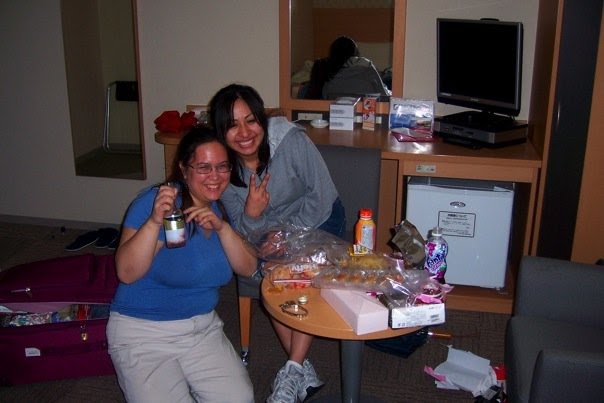
But we made it. The Comfort Inn was a typical business hotel. It had Western beds and our own private shower and bath. We got TV and a desk, instant coffee and a set of pajamas and a small toiletry set containing a razor, a brush, and a toothbrush. What fascinated Jenny most of all was a chemical put on the bathroom mirror; when the shower fogged up the room, one patch of glass remained clear.

Hedy had the single non-smoking room and Jenny and I shared a twin smoking room, which was the only option available at the time of the booking. Our room still smelled of smoke. Jenny told me to open the window. The wind made a rushing sound, like the ocean, and I looked down to see the sidewalk, nine stories below. It was an unobstructed fall. The sight made my palms sweat and my stomach a bit fluttery.

“That window is scary,” I said. “It feels like the wind will just suck you out.”

We hit the combini—the convenience store—after that. Once we had our (non-alcoholic) drinks, we all hung out in our room, the sound of the wind in the background. Jenny and I had brought snacks. I had brought souvenirs from Kanoya: “Black pork” chips, sweet potato cakes, and rose-flavored castella cakes. Jenny brought guava cookies, pumpkin cupcakes, and banana chips. For about an hour, we ate, drank, and were merry. Then jet lag began to set in. It had been a long day.

Jenny went to bed at about 9:30. I went to bed later—about 10:30 or so.

Anecdotes #1: Airport

April 25, 2008

Day 1: Thursday, March 20th
Tokyo

It was a beautiful morning. The sky was blue without a wisp of wind. Perfect weather for traveling. It was so warm, it was almost a shame to shrug my heavy coat over my T-shirt—but I figured I’d better bring that coat just in case.

I rode the bus to Kagoshima airport, listening to my ipod and watching the scenery. As we got into the mountain, there was nothing but yellow trees and leafy bamboo—a few houses here and there. I got to the airport early and wandered around until I became accustomed to my surroundings. It didn't take long.

When at last the plane came, I took a seat near the window. I could see the bay as we rose and I could see Sakurajima, our volcano, a wisp of smoke at its top. There were houses and square patches of rice paddy land.

This was not my first plane ride alone, but it was the first plane ride I had planned so completely by myself. I had bought the ticket online. I had gotten to the airport. I had made my way through check-ins, baggage checks, and gate numbers. It was a small accomplishment and caused me no particular trouble, but I was proud. Another form of transportation mastered.

When I came to Tokyo, it was raining.

But that wasn’t my first concern. Haneda airport was large and confusing. There were so many gates and people crisscrossing my path, that I immediately felt disorientated. I got my bags and checked the clock. I was running late.

It was already 2:30. Hedy’s flight came in at 4:40. And I still had to get to Narita.

There are two airports in Tokyo. Haneda is closer to the city and is used mostly for domestic flights. Narita, however, is far on the outskirts, possibly in another city. This is the airport used for international flights.

I bought a bus ticket to Narita airport. Then I stared blankly as the man loading baggage asked which colorful band I’d like attached to my suitcase. Apparently, there were three different locations at Narita that the bus stopped at: Terminal 1a, Terminal 1b, and Terminal B. I had no idea which terminal my friends would be arriving at. The man at last tied a blue band around my suitcase.

By sheer luck, he’d picked the terminal Hedy was arriving at, Terminal 2. (Inside the bus, there was a chart, which rather belatedly told me which flights went with which terminal.) Once there I had trouble finding the Arrivals gate. I asked someone and she told me the floor. Then I had trouble finding escalators. They were all over the place.

I found the floor. I found Hedy’s flight and her gate. I waited.

I should tell you now that Hedy and Jenny were not coming on the same flight. Jenny’s plane was 20 minutes later than Hedy’s and she arrived in a different terminal. The plan, hastily conceived, was that I would meet Hedy at the baggage claim, and then we’d meet Jenny at the gate. This was before we knew that Jenny and Hedy were in different terminal buildings. This was also before I rode my flight to Haneda and remembered one crucial fact: in Japan, you pick up your bags before you go out the gate. In other words, you can’t meet your party at the baggage claim.

I was monitoring Hedy’s flight and I noticed she was taking forever in customs. An hour past, but still I waited. Then suddenly, I heard my name on the speakers. I was being paged. What had happened? Had I missed Hedy?

“Do you know someone named Jenny Wong?” the woman at the desk asked me.

“Yes,” I said while thinking, How did she get in so soon?

The woman made some phone calls. “Jenny will be coming. Wait here.”

I waited, but I was impatient. Hedy should be coming out any minute. I had waited for her for so long, and I didn’t want to miss her now. I conveyed my anxiety to the woman and she paged Hedy.

At that very minute, I saw Hedy walking toward me.

It turned out she had come out of the gate late because she was taking her time at the baggage claim. It took her a few minutes to realize it was not a meeting spot, and she wasn’t sure what to do next. She must have come out the gate just as I was making my way to the information desk, because she didn’t see anyone. She was about to step out of the building and hunt Jenny down—which would have been a disaster since Jenny was on her way here. But she decided to ask information first and then she saw me.

When Jenny finally arrived, we all hugged. I was so relieved. Meeting my friends in Tokyo was the thing I had worried about the most. Now that we were together, the worst was over.

Postcard of Tokyo and Kyoto


April 25, 2008

I left for Tokyo on March 20th. A Thursday. A public holiday, by a strange fluke of the calendar. I took the bus to Kagoshima airport, about 2 hours away. I had no problems catching my plane.

Things got more confusing when I came to Tokyo. I came out at Haneda Airport, which was larger, more full of people, and generally more confusing, but that wasn't the problem. The problem was there are two airports in Tokyo. Haneda is for domestic. Narita is for International. My friends were at Narita.

I took a bus to Narita. My friends came on two separate flights, in two different areas, 20 minutes apart. We nearly missed each other, but it turned out all right. We ate dinner at the airport and my friends were impressed by my Japanese speaking ability.

We stayed at the Comfort Inn, in Narita, a suburb of Tokyo. It was a business hotel, which meant it was much like any normal hotel you’d find in America, but a little more condensed.

Shinkansen

The next day, we went by shinkansen (bullet train) to Kyoto. Jenny and Hedy learned the perils of over packing, as they were forced to drag their enormous suitcases up and down stairs, onto trains, and through stations of moving people. Once in Kyoto, we got lost trying to find our hostel. Finally, we took a cab.

We stayed at the BaKpaK Hostel. We shared our room with about twelve people, including boys. But really, the only problem I had was that we had to be quiet at night and in the mornings, so as not to wake people. Oh, and I couldn’t just dump my stuff everywhere, either.

That night we ate Ramen and explored downtown Kyoto. I might have seen a geisha.

Nara deer

On day three, we finally got to do some sightseeing. I pretty much set the agenda. First we went to the Imperial Palace Park. The actual Palace was off-limits, but we had a pleasant stroll and enjoyed the flowers. Unfortunately, Jenny lost an earring.

We went to Ryoan-ji, a temple with a famous rock garden. The rock garden was a little disappointing. It was small. We had more ramen for lunch. (I was starting to get sick of noodles at this point.) Then we went to Kinkaku-ji, the Golden Pavilion Temple. The most impressive thing about that temple was it’s ability to attract hordes of tourists, but still photograph like you were the only one there.

Big Buddha

Our last stop was Nijo-jo, a castle. It was a small castle, but I loved the architecture. On the way back, we took a jam-packed bus. I swear, no train in Tokyo was more crowded than that bus. We were tired after that so we had dinner, did a little shopping, watched a bad T.V. movie after that.

The next day was Easter Sunday. We rented bikes. We rode to Heian-jingu, a shrine with a nice garden. We also rode to Nanzen-ji, a temple with paintings of tigers leaping through bamboo inside. I had been to both places before, but liked them better the first time. We also went to a craft center and I bought two yukata (light cotton kimono) for 3000 yen each.

Swap Meet

The fifth day, we moved from the hostel to a ryokan near Kyoto station. A ryokan is traditional, Japanese-style hotel. It has tatami mats and you sleep on futons on the floor. I find it more comfortable than business hotels. The three of us shared a room. We had more privacy that way.

I was glad that we transferred hotels, even though the move took all morning. Now that we were closer to the station, we could make day trips. After lunch (donburi: meat over rice), we decided to make a short trip to Uji, a city about fifteen minutes from Kyoto, and then stop by Fushimi Inari.

Himeji

I wanted to go to Uji because I wanted to see Byodo-in, the famous Phoenix temple, which is featured on a 10-yen coin. It was a very nice old temple. We also visited the shrine, a world heritage site, and crossed some bridges. Uji was a nice little town and we liked it very much.

We bought Bento (boxed meals) at Uji and took them to Fushimi Inari. Fushimi Inari is a shrine on a mountain, famous for tunnels and tunnels of orange torii. We decided to go in the evening, when it was most creepy, and have a picnic on the mountain. Hedy was unfortunate enough to get natto sushi. Natto, fermented soybeans, is one of the nastiest dishes in Japanese cooking. We climbed to the top of the mountain. Then it got dark. Going down, Jenny and I began to get frightened, but Hedy had nerves of steel.

Osaka

The next day I got dressed up and wore my yukata. Hedy did my hair. Jenny wore a dress and Hedy a skirt. We went to Nara. We fed the deer and saw the big Buddha. Then we came back to Kyoto and went to a swap meet. We went to an onsen, a hot springs, though in this case it was more of a public bath. That’s right, a bath: you go in naked. Hedy didn’t go. Jenny and I did, because we had gone out of our way to find the place and were very footsore. Needless to say, it was a little awkward. I regretted wearing my yukata to the onsen. It was hard to put it back on and a felt a little like a tourist.

America Mura

After that, it was our castle day. We went to Himeji, which has an old, famous castle. Then we went to Osaka Castle, which was a recreation of the original. Inside the castle there were museum exhibits and I brushed up on my history. We also went to America Mura (Village), a shopping district in Osaka, which, despite it’s name, was nothing like America and not so much as a Baskin Robbins in sight.

The next day was Thursday again, March 27th. We packed our bags and went back to Tokyo, by bullet train again. We met Rihito, who had been a Japanese exchange student when we went to college at Redlands. He took us to the Tokyo Tower, which had a magnificent view. We went to dinner at TGI Fridays. I was so happy to go to an American restaurant. I ordered fajitas. I knew I missed Mexican food. I had no idea how much I’d missed sour cream. (There’s none in Japan.)

Tokyo Tower

We went back to our hostel. The Sakura Hostel was located in Asakusa, the old entertainment district in Tokyo. Our hostel was really small. There was almost no space to house our luggage and we couldn’t spread out at all. The lounge was always full of people, so we had no space to call our own.

For breakfast the next morning, we went to a conbini (a convenience store) and bought bread. We carried our food to Senso-ji, the temple in Asakusa. It became our breakfast spot. We would sit on the steps, under the sakura, and watch the strange things that happened. Once there was a TV show being filmed. Another time, some sort of festival was going on. When we finished our breakfast, we’d walk down the path, lined with stores, until we got to the subway.

Okonomiyaki

That day, we went met Yuki, another exchange student. We walked around the park and looked at the sakura, the cherry blossoms, now in full bloom and splendid. Then we walked around Harajuku. Despite the Gwen Steffani hype, it was really rather ordinary. We had all-you-can-eat, make-your-own okonomiyaki for lunch. Okonomiyaki is like a savory pancake. We did more shopping and were surprised to find that even in Tokyo, department stores close at 8:00 on a Friday night. Like in Kanoya.

The 10th day we went to Ueno, a park. I wanted to go there because the final battle of the bakumatsu had been fought there in 1868; afterwards, Japan entered its modern era. However, the presence f so many people doing hanami (literally looking at the flowers; having a picnic to enjoy the sakura) rather distracted me from the historical element. We went to a very nice museum, which gave a history of Japan through art and artifact. Then, we visited a cemetery.

Hanami

After lunch we walked down a street near the park, Ame-something. It was an old street. It was completely packed. We didn’t so much walk as ooze. That was, without a doubt, the most crowded shopping area, this obscure street.

We went to Shibuya, a more modern shopping area, and I found a whole floor of English books in a Tower Records. The fantasy section alone was the same size as the entire English self in my bookstore in Kagoshima. I was so happy. My friends just left me to browse while they did more shopping.

Yakiniku

For dinner, I treated them to yakiniku, or Japanese-style barbeque. They had fun, and so did I. It was our last evening together. Hedy was leaving the following day.

The next morning, after breakfast at Senso-ji, I took Hedy to the airport. We decided to split up, so Jenny could do more shopping. (She was starting to get frustrated about finding souvenirs.) Hedy and I had a nice chat on our train ride to the airport. Unfortunately, I had underestimated the time it would take to get there and back. I was late and kept Jenny waiting for over an hour. We did more shopping. Then we went back.

Monday, March 31st. We went back home.

This, long as it seems, is a general overview. I tried to write long in-depth ancedotes, but I ran out of steam halfway through, after about 20 pages or so. For the half I completed, see the anecdotes.