Saturday, April 10, 2010

Setsubun


February 3, 2010

Happy Setsubun!

It's February 3rd here in Japan and that means it's the day of the bean throwing festival. I consider Setsubun the equivalent of St. Patrick's Day, given that you don't get a day off from school or work and I almost always forget about the holiday until it's literally the day of. Today, I was reminded just after fourth period when my teacher commented to a student that she was being strict with him, "like an oni," and the student responded by pretending to throw beans at her.

Supposedly families, especially ones with young children, celebrate Setsubun by throwing beans and saying, "Oni wa soto, fuku wa uchi," which translates into "Demons begone! Happiness arise!" if you're being poetic, or, more plainly, "Bad luck outside, good luck inside." I have no idea who sweeps up the beans when all is said and done, because I've never seen that part celebrated. The most I've seen are a lot of teasing about who's an oni. Oh, and I got some peanuts today, which apparently qualify as beans. Heck, for all I know, they might technically be beans. Does anyone know the classification of peanuts? I know, thanks to an insanely old trivia robot, that a peanut is neither a pea nor a nut.

Setsubun is also celebrated by eating gia-normous rolls of sushi. I usually skip this part along with the beans, but today I didn't feel like cooking, so I picked up a log of deep-fried shrimp sushi. There's some sort of lucky direction you're supposed to eat it in, but I didn't bother to find out which one.

I am happy about Setsubun for two reasons. The first has to do with what the word Setsubun means. "Setsu" comes from the word "kisestu" and means season. "Bun" means split. The splitting of the seaons, which means, that winter is sort of unofficially at an end and spring is on it's way. Granted the first time I "celebrated" Setsubun (by receiving beans) I was in Nagoya and it snowed the next day. But I can feel signs of spring coming. The ume (plum) blossoms are starting to bloom, little and white and sweetly scented. I love ume, what I consider the first sign of spring. There are other little signs, too. My energy has been going up, and I've been more efficient and motivated. It's still cold, and yet the cold isn't really bothering me anymore. Once I've adapted to one season, it's a sure sign the next one is on its way. I'm happy, because I love spring. I love the weather, the flowers, and how inexplicitly genki I become.

The second reason I'm happy has nothing whatsoever to do with Setsubun. I just got the results from my JLPT, that ridiculously difficult test I've been studying for for the last two years. And guess what? I PASSED! I squeaked by with a 63%. (Passing is 60%) I got 76% on kanji and vocab, 61% on listening, and 58% on the doubly weighted reading and grammer. Level 2 means, and I quote, "The examinee has mastered grammar to a relatively high level, knows around 1,000 kanji and 6,000 words, and has the ability to converse, read, and write about matters of a general nature." Come to think of it, that sounds rather bland. A more concrete example: today I listened to a Japanese teacher (that is a teacher of Japanese) explain the meaning of an old, obscure Japanese quote in Japanese and I understood it, without asking an English teacher for translation or cracking open a single dictionary.

Sorry to brag so much, but I'm just in such a good mood. I think I'll celebrate by eating strawberry-flavored mochi ice cream.

Have a nice Setsubun!

Translation: Saigo Nanshu Memorial Musuem


(A pamphlet I was asked to translate from the Saigo Nanshu Memorial Museum. The director “highly evaluated” my work.)

Welcome to the Saigo Nanshu Memorial Museum

(Building Guide)

The Saigo Nanshu Memorial Museum took life as an enterprise in 1977, marking the 100 year anniversary of Saigo’s death. It was made possible through the private donations of over 200,000 individuals who wished to honor the Elder Nanshu, officially known as Saigo Takamori*. After completion, ownership of the museum was transferred to Kagoshima City in 1978, with management entrusted to the Foundation for the Saigo Nanshu Memorial Museum Committee.

* Please note: All names are written in the Japanese style, with family name first and personal name last.

Route: Museum and Shrine (Estimated time: 30-60 minutes)
(From the front of the parking lot) Museum-Graveyard-Nanshu Shrine and Epitaph for Fallen Soldiers

Parking (free) Up to 10 buses and 50 mid-sized cars

Architectural Outline Main building. Total area: 550 m². Basement: 75 m² (furnace, storage). First floor: 264 m² (office, display). Second floor: 211 m² (display). Equipped with air conditioning. Annex Building. Area: 230 m². 30 desks, 120 chairs, 2000 books. Can be used for display or research.

Museum Hours 9AM-5PM (tour takes 15 minutes at a quick pace, 60 minutes at a leisurely pace)

Holidays Monday (should Monday fall on a national holiday, the museum will be closed on the following business day) New Year (Dec. 29th-Jan. 1st)

Admission Adult: 100 yen. Child (Elementary and Junior High): 50 yen. 20% discount for groups of 30 or more.

Address: 2-1 Kamitatsuo (Nanshu Park), Kagoshima City, 892-0851
Telephone: 099-247-1100 FAX: 099-247-1100

By Route Bus, get off at Tateba; from there, a 7 minute walk
By City View Bus, get off at Nanshu Park Entrance (Nanshu Koen Iriguchi); from there a 6 minute walk.
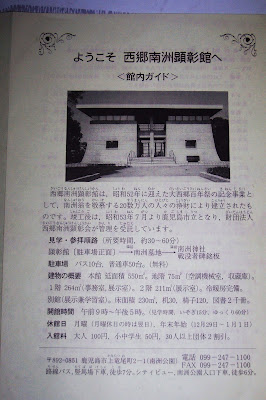


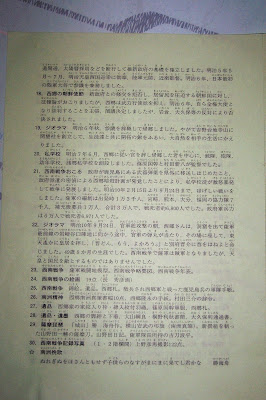
[Display Contents] [1st floor] There are 10 dioramas in this museum.

Entrance Original bronze statue of the Elder Nanshu (Saigo) in dialogue with Elder Suge “Fallen Cow” Gagyu.

Lobby Portrait (1889, by Italian artist Kiyosone)

1. Timeline of Saigo’s Life Saigo was born on January 23, 1823 and died at Shiroyama on September 24, 1877. He attained the rank of Shosanmi posthumously in 1889.

2. Diorama The Town of Great Men. Many leaders of the Meiji Restoration came out of the Shitakajiya district, one after the other. They included the Saigo brothers, Okubo Toshimichi, Yoshii Tomozane, Iji Chishoji, Shinohara Kunimoto, Murata Shinpachi, Oyama Iwao, Togo Heihachiro, and Yamamoto Gonnohyo’e.

3. The Young Saigo From age 21-25, Saigo studied Zen under the instruction of his teacher, Musan. He was also educated in a neighborhood school, called a Goju.

The Goju was an independent school system unique to Satsuma (Kagoshima). The students in the Goju were ranked from highest to lowest: Head of Nise (older students)- Nise - Head of Chigo (younger students) - Older Chigo - Younger Chigo. The Goju also functioned as a warrior group where young men voluntarily trained their bodies and minds, the older students teaching the younger students and the Head of Nise supervising all. The textbooks were Satsuma Government Educational Reader, Kagoshima Domain Reader, and Four Books and Five Classics.

4. Diorama Saigo was selected as Head of Nise for Shitakajiya Goju when he was 19 years old. In this small district of about 70 houses, many future leaders of the restoration grew up under the guidance and influence of Saigo. Their education included an exercise regiment of running up mountains to build leg strength, a balance of diligent study and vigorous martial arts, and the cultivation of loyalty and filial piety, according to the aims of the Goju schooling system.

5. Annual Character-Building Events of the Goju (Dates according to the old lunar calendar.) May 28th—Sogo Don’s Umbrella Burning Festival. June 23rd—Visit to Jisshin Temple (Takeda Shrine). July 18th—Visit to Shingaku Temple (Hiramatsu Shrine). September 14th—Visit to Myoen Temple (Tokushige Shrine). December 14th—Reading of the Tale of the Akogi Warriors, known in the West as the 47 Ronin—a group of samurai who severed ties with their home to avenge their fallen master. Licensing of Jigen-ryu-style swordsmanship. The Jigen-ryu Bokuto, which involved training with wooden swords in the sea at New Year.

6. Diorama When he was 17, Saigo became a clerk in the government office which was responsible for collecting taxes (paid in rice) from the farmers. But Saigo, a man of deep compassion and justice, sympathized with the farmers and often broke off his own small salary to help the sick, the poor, and the suffering. He wrote up reports of the unfair dealings he saw and sent them to his superiors.

7. The Great Accomplishments of Shimazu Nariakira Shimazu Nariakira was the 28th Lord of Satsuma Domain and a great influence on Saigo’s life. He was responsible for buying the Shohei-maru, a modern ship from England; he created the Hi-no-maru design used on the Japanese flag; and he encouraged Satsuma kiriko, or cut glass.

8. Diorama At the age of 26, Saigo was discovered by Shimazu Nariakira and became a gardener in Edo (Tokyo). (At the time all lords were required to keep a separate residence at Edo and visit every other year.) Nariakira took Saigo under his wing. He gave Saigo the important task of monitoring events and meeting some the most prominent people in the entire country. Before long Saigo inherited Nariakira’s will to reform the government, and this would lead him to accomplish some of the greatest deeds of the revolution.

9. Diorama During the Ansei Purge (a time when people who stood against the government were silenced, imprisoned, or executed), the monk Gessho of Kiyomizu Temple in Kyoto was pursued by the Shogunate. Gessho begged Saigo’s help, and Saigo offered him the protection of Satsuma. But after the death of Nariakira, Satsuma feared the Shogunate and banished Gessho to Hyuga. Saigo, loyal to the end, decided to die alongside the monk. One winter’s day they flung their bodies into the frigid waters of Kinko Bay. (Saigo was 30 at the time, Gessho was 44.) Gessho died, but Saigo was resuscitated.


10. Resurrected Saigo After he was revived, Saigo changed his name to Kikuchi Gengo. For the next three years, from 1859-1862, he hid away on the island of Amami Oshima in the village of Tatsugo. A stone monument dedicated to Saigo in Rutakuchi (in Amami Oshima). A tray used by Saigo. A stone monument dedicated to Gessho.

11. Banished Again In February 1862, Saigo was recalled back to the mainland. He immediately became busy in national affairs, which stirred up the anger of the new lord of Satsuma Domain, Shimazu Hisamitsu. As a result, Saigo was banished to the distant islands of Tokunoshima and later Okinoera Bujima (Wadomari), where he was imprisoned for a year and a half.

12. Diorama Saigo spent a total of 5 years on the Amami islands, from the age of 31 to 36. For the first three years after entering the water with Gessho, he remained hidden in Tatsugo village to escape the eyes of the Shogunate. After that, he was imprisoned in Tokunoshima and Okinoera Bujima for provoking Hisamitsu’s wrath. He endured this without complaint. In the midst of his suffering, Saigo forged his temper and grew in spirit.

13. The Satcho Alliance In 1866, after Saigo was brought back from the islands yet again, there was a secret agreement between former rivals Satsuma Domain and Choshu Domain (Yamaguchi Prefecture), made possible through the efforts of Sakamoto Ryoma. With Satsuma and Choshu now united under the slogan of Tobaku (“Overthrow the Shogunate!”), they received a secret Imperial edict in 1867, lending legitimacy to their cause. People who played active roles in the Satcho Alliance were Saigo Takamori, Komatsu Tatewaki, Kido Takayoshi, Sakamoto Ryoma, and Nakaoka Shintaro.

14. Diorama Although the last Shogun, Tokugawa Yoshinobu, had abdicated at the end of 1867, the supporters of the Shogunate continued to wage war in his name. In January 1868 their 15,000 man army advanced to Kyoto and met Saigo’s 5,000 man army at Toba Fushimi, where they opened fire. The supporters of the Shogunate were defeated. Hoisting an Imperial banner overhead, Saigo, as Eastern Expeditionary High Command, left Kyoto on February 14th and marched his army to Edo to attack the Shogun’s stronghold and decisively end the war.

15. Diorama The date for the Imperial Army’s all-out offensive was fixed for March 15, 1868, and had such an attack taken place, the chaos within Edo would have been like poking a beehive with a stick. The army governor of Edo, Katsu Yasuyoshi (also known as Katsu Kaishu), saw the impending crisis clearly and requested a meeting with Saigo Takamori. With good will and sincerity, two great men met and talked out an agreement. In the end, Saigo ordered the offensive to be canceled. On April 11th Edo Castle was taken without bloodshed, sparing millions of people in Edo the fires of war.

Television Room Broadcasting the life of “Saigo Takamori.” Time needed: 30 minutes. “Saigo and Okubo,” presented by the Prefecture Scholarship Association, 20 minutes.

[2nd Floor]

16. The Proverbs of Elder Nanshu Shonai Domain (the Tsuruoka region of Yamagata Prefecture) had continued their assault on behalf of the defeated Shogunate, but by October 1868, they admitted defeat and surrendered to Saigo, now head of the Northern Expeditionary Attack Force. Rather than punish Shonai Domain, Saigo treated them with kindness and leniency. In later years a close friendship would develop between them. When Saigo was branded a traitor, the people of former Shonai defended him and in 1889 published The Proverbs of Elder Nanshu, which spread the knowledge of Saigo’s great character throughout the country.

17. Saigo as Sangi In 1869, at the request of Shimazu Tadayoshi, the last lord of Satsuma Domain, Kagoshima was reformed into an assembly government.

In 1871, Saigo achieved the high rank of Sangi and took with it corresponding duties on the national stage. From then until his resignation in October 1873, Saigo actively endorsed many important policies, including the abolishment of domains and the establishment of prefectures, reform within the Imperial Palace, a new educational system, the establishment of a national bank, the creation of a universal conscription army, the inauguration of the railroads, the adoption of the solar calendar, and so on. From May to July of 1872, he escorted the Meiji Emperor on a tour throughout western Japan and Kyushu as Commander in Chief of the Imperial Guards. In June 1873, in addition to Sangi, he took on the role of General of Japan’s first national army.


18. Saigo’s Korean Envoy Korea rejected a treaty with new Meiji government. Between this and its oppression of Japanese settlers, animosity towards Korea was building and a debate broke out over whether or not to go to war. Saigo suppressed the sect that favored using military force. In 1873, he proposed instead that he be sent to Korea as an ambassador. Although the Cabinet meeting initially supported Saigo’s Korean envoy, opposition from Okubo and Iwakura ultimately caused this proposal to be rejected.

19. Diorama In the fall of 1873, Saigo retired from his position as Sangi and returned home. Before long, he had established a society to reclaim the land along the Yoshino plateau and Terayama region. Wielding a hoe to break the ground, Saigo and his students returned to a life of being partners with nature.

20. Saigo’s Private Schools When Saigo retired, many in the government also left their posts to follow him back to Kagoshima. Bearing these men in mind, Saigo founded a system of private schools in June 1874, which included a rifle corps, a cannon corps, and basic education for young pupils. Shinohara Kunimoto and Murata Shinpachi were supervisors.

21. The Seinan War Begins The national government began to ship weapons and munitions out of Kagoshima. At this time, a spy revealed that there was a scheme in play to assassinate Saigo. Hearing this, Saigo’s students went off in a rage, which eventually progressed to a full-scale war against the government. At the time of their departure for Tokyo, there were 13,000 men in Satsuma’s army, but cooperative armies from Miyazaki, Kumamoto, Oita, and Fukuoka comprised another 7,000 men, and a supplement of recruits added another 10,000 men, for a total of 30,000 men. Roughly 6,800 of these men would die during the course of the war. The government army was 60,000 men strong, and they would absorb 6,971 casualties by the end of it.

22. Diorama On September 24, 1877, the morning of the Imperial Army’s general offensive, Saigo left his cave, and his army took their position at the mouth of Iwasaki Valley in Shiroyama. As he was making his way to the front line of the Satsuma army, Saigo was hit by a bullet from the Imperial Army and sat where he fell. He prayed to the Emperor in the far-off east and turned Beppu Shinsuke. “Shin, it is time,” he said to Beppu and ordered his friend to strike off his head. Although officially Saigo and the Satsuma army were called traitors, the Emperor and the people did not in their hearts think of Saigo as an enemy.

23. Seinan War Miniature battleground of the Satsuma Army. Rough sketch (with omissions) of the Seinan War. Chronology of the war.

24. Pictures of the Seinan War 19 pictures (Artist: Osa Hidehiko)

25. Seinan War Brocade picture. Articles of the deceased. Saigo bill. Military notebook of a Kagoshima soldier who fought against Saigo’s troops.

26. The Spirit of Nanshu Hanging scrolls written in Saigo’s own hand. 10 scrolls. Saigo Takanaga’s (Takamori’s) letter. Murata Sansuke’s Letter of Appointment.

27. Articles of the Deceased Kamoshimo (old ceremonial dress) bearing Saigo’s family crest with cotton crested haori (half jacket). Shinohara Kunimoto’s military uniform. Saigo bill.

28. Articles and Letters of the Deceased Saigo’s leggings and underclothes. Letters of Oyama Tsunayoshi and Kirino Toshiaki. Letters of Okubo Toshimichi.

29. Satsuma Biwa (Lute) “Shiroyama,” composed by Katsu Kaishu. A flag draped in black belonging to Yokoyama Yasutake (Nanshu original writing). The Satsuma blade of Yamanoda Kazusuke, who cut down many Shinsengumi, a band of samurai in Kyoto who supported the Shogunate. Yamanoda’s diary. Naminohira, the old sword of the commander of Satsuma Army.

30. Photographic Record of the Seinan War (1st and 2nd floor transom) 122 pictures. Taken by Ueno Hikoma.

Nanshu Elegy

“With false accusations hung upon him like laundry on a line, he died, at the mercy of the games of children.” —Katsu Kaishu
Translation: Okubo Toshimichi


(From the Museum of the Meiji Restoration, in Kagoshima City)

The Tragedy of Okubo Toshimichi

The Meiji era deepened and history treated Okubo coldly. In Kagoshima, he was censured as the man who drove Saigo to his death during the Seinan War (1877). The image of Okubo’s character hardened into that of a cool-headed realist, a man who mulled things over dispassionately, made a decision, and carried that out that decision to the end, regardless of human consequence.

But in a national crisis like the Bakumatsu (the ten year collapse of the Tokugawa Shogunate), it was necessary to make and implement decisions in a composed manner. Okubo’s firm-to-the-extent-of-heartless posture steered Japan through the Meiji era and put it on course to be an independent nation, unyielding to the pressure of foreign countries.

In the 11th year of Meiji (1878), Okubo was assassinated by a band of disgruntled samurai. After his death, a different side of his character came to light. People had imagined that a man who had sat in the seat of power for so long had accumulated quite a bit of money. Actually, he had 75 yen in cash (in current value, approximately 1 million yen) and a total debt of 8,000 yen (100-140 million yen). He assumed these debts under his own name to supplement a shortage of government funds. This shows Okubo to be a man who threw away his own self-interests and sacrificed everything he had for the nation.


When He Learned of his Friend’s Death

From the days of their youth, Saigo and Okubo grew up together, strong-willed and like-minded. But when they reached middle age, their opinions split and finally, in the Seinan War, they were forced to become enemies. Okubo was a man who hid his regrets and always exhibited a calm exterior, but when he learned of his friend’s death, his true feelings were laid bare. His younger sister Mineko related the confusion that seized Okubo upon hearing of Saigo’s demise:

“My big brother, whose stature was so tall, walked in circles under the lintel between the sitting room and the hallway. He was impatient, refusing to sit, and he smacked his head with his hand, a great many tears filling his eyes.” We can imagine at this time that memories of his old childhood friend were circulating in his mind.

Later, Okubo would make this request to Shigeno Yasutsugu, a historian living in the same town: “I wish to write the inscription upon Kichinosuke’s (Saigo’s) tombstone.”

A Warm Affection and Respect for his Wife

The face of Okubo as a family man is not well-known to the public. Although considered “cold-hearted” and “unfeeling,” a different portrait of Okubo can been seen through a small number of materials and family accounts.

While Okubo was away Edo and Kyoto trying to bring about the Meiji Restoration, his wife, Masuko, protected the house in Kagoshima, along with their children and her husband’s parents and sister. Although they were separated by a great distance, Toshimichi was forever thinking of his wife and the great labors she performed. He always began letters addressed to his house with “My Dear Home” (his affectionate name for Masuko), and even when he sent letters to his younger sister, the first name he wrote on the paper was “Masu.” * This shows the respect he had towards his wife, as well as his thoughtful consideration of her.

When he traveled to America as part of the Iwakura Delegation, he attached this line of a song to the end of a letter to his wife: “Wherever I go, my thoughts surround you. My wife, who beats at the loom, as the dusk of the autumn sky deepens to black.”

* It has been speculated that by doing this, he gave his wife permission to look over his sister’s letter and be sure he wasn’t speaking ill of her behind her back. This also, in a sense, set her up as head of the household, as it gave her the authority to oversee items that came into the house.


Isei Seimei

Okubo often wrote out the calligraphy for “Isei Seimei,” or “Pure Ruler.” The words mean “Politicians must first examine their own character and have integrity and righteousness,” and they express Okubo’s desire and lifelong aim.

The Accomplishments of Okubo Toshimichi

• Okubo is one of the Ishin Sanketsu, the Three Great Men of the Restoration. Moreover, he was the only one to consistently play a role in the center of government politics and thus was able to carry out extensive reforms.

• Okubo was a part of the Sono (“Revere the Emperor!”) movement. He advocated government change within the domains, organized the loyalists, and caught the eye of his mentor, Shimazu Hisamitsu (the new head of Satsuma Domain), who saw Okubo’s talents and utilized them to the fullest extent. Alongside Saigo, Okubo recruited like-minded men to their cause and synthesized various domains’ arguments on how to deal with the crisis. He traveled all over Japan to promote the idea of uniting the feudal domains into a single national government, and he actively endorsed restoring the Emperor to power and returning all land to his control.

• The two times Saigo was banished to the islands—once to Amami Oshima to hide from the Shogunate and then to Okinoera Bushima—Okubo went to work in the government to get him released. Once Saigo did return, he and Okubo combined their talents and the Meiji Restoration took off.

• After the inauguration of the new Meiji government, Okubo pushed for the transfer of the capital from Kyoto to Tokyo. He came out with new government programs, one after the other, and he was especially adamant about creating a prosperous country with a strong army and promoting enterprise and industry. He poured all his energy into making Japan a modern nation.

• After Saigo helped him abolish the domains and establish prefectures in their stead, Okubo went on an overseas expedition with Iwakura Tomomi, among others, to tour Europe and America. Prussia’s Bismarck, in particular, made an enormous impression on him, and once he returned, Okubo enthusiastically devoted himself to creating a monarch-state similar to that of Prussia.

• In Okubo’s absence, Saigo had been left in charge of the government and had planned to send an envoy to Korea. This clashed strongly with Okubo’s own ideas of prioritizing internal matters. Sadly, the fallout between the two would eventually lead to the Seinan War, but Okubo, as Minister of National Affairs, did his best to control the crisis.

• Okubo was assassinated on May 14, 1878, a year following the Seinan War. His killers were six disgruntled samurai led by Shimada Ichiro of Iwakawa Prefecture. At the age of 47, Okubo’s life came to an end.

• Okubo was given the rank of Shoni’i and the prestigious title of “Minister of the Right.” Afterwards, he was awarded the rank of Juichi’i.


Please note: All names are written in Japanese style, with the family name first and the personal name last.

Translation: Saigo Takamori


(From the Museum of the Meiji Restoration, in Kagoshima City)

A Man of Virtue Trusted Even by His Enemies

During the Boshin Civil War (1868-1869), Shonai Domain (located in present day Yamagata Prefecture), which was a supporter of the Tokugawa government, came under fierce attack by the Imperial Army and was defeated. It is well-known that, under the influence of Saigo, the “rebel army” of Shonai Domain was treated magnanimously, and as the government changed and the Meiji era began, Shonai Doman felt an obligation and special trust for Saigo.

In the 4th year of Meiji (1871), Suge Sanehide, the chief retainer of Shonai Domain, met with Saigo in Edo (Tokyo) for the first time. The record of Shonai Domain contains the following statements: “The Elder (Saigo) is honored as an older brother” and “The Elder is in fact a great Sage, bestowed with Oyu’s gift of virtue.” It was also written that the previous year the former ruler of Shonai, Sakai Tadazumi, personally studied under Saigo during his visit to Kagoshima, and his retainers trained with riffles as rank and file soldiers in Hayato Garrison in Satsuma (Kagoshima Prefecture). Due to this association, a number of people from what was once Shonai Domain joined the Satsuma troops at the outbreak of the Seinan War.


Men Who Put Their Lives in Saigo’s Hands

There seemed to be a special kind of power to Saigo’s charisma. After the inauguration of the new Meiji government, Saigo differed in opinion with Okubo Toshimichi and Kido Takayoshi over whether or not to dispatch ambassadors to Korea and was subsequently dismissed. When that happened, many Satsuma officials holding high positions in the government also resigned and returned home to Kagoshima under the direction of Saigo. The number reached into the hundreds, including such distinguished men as Shinohara Kunimoto, the Major General of the Imperial Guards; Kirino Toshiaki, the Chief Justice of the Army; and Murata Shinbachi, the Deputy Chief of the Imperial Household. Many of these military officers and public officials would later take part in the Seinan War and share in Saigo’s fate.

Masuda Sotaro, who was in command of Oita Prefecture’s Nakatsu Corps, said this about Saigo: “If you know Saigo for a single day, the love of one day is born. If you know Saigo for three days, the love of three days is born. With each day, the love for him increases, until it won’t let go. It is enough to live and die with him…” The men who followed Saigo to their death at the end of the Seinan War probably thought the same thing. It is for this reason that Saigo is called “A person of great affection.”


The Mystery of Saigo’s Real Name

Although it was common for samurai to change their names several times over the course of their lives, the amount of names Saigo went through was excessive even for the time. (See chart.)

Age Name Reason for Change

Birth-14 Kokichi In Saigo’s family, this was the traditional name for the eldest son and heir.

15-26 Kichinosuke This was used from Saigo’s coming of age on forward.

27-29 Zembe Saigo took this name after his father’s death when he inherited control of the family.

32-35 Kikuchi Gengo During the time of the Ansei Purge, Saigo harbored the monk Gessho, a fugitive. Saigo was forced to change his name by edict of Satsuma Domain.

35 Oshima San’uemon The name he took after being reinstated and returning to Kagoshima.

35-37 Oshima Kichinosuke When Saigo was banished to Okinoera Bujima (an island in southern Kagoshima Prefecture near Okinawa), he was again ordered to change his name by domain edict.

38-40 Saigo Kichinosuke

41-Present Saigo Takamori

Takamori was not, in fact, Saigo’s real name. His real name was Takanaga; Takamori was the name of his father. However, when Saigo was awarded the rank of Shosanmi in the 2nd year of Meiji (1869), the government made a mistake in their documentation and used his father’s name instead. Saigo ended up refusing this rank, but in doing so, he sent back the name “Takamori.” From that time forward, Takanaga and Takamori were used interchangeably until the last years of Saigo’s life, when the name Takamori stuck.


Kei Ten Ai Jin

The words Saigo carried with him all his life Kei Ten Ai Jin, or “Revere Heaven, Love Man” mean “As Heaven blesses all people without discrimination, so I, too, with a heart of compassion, want to love mankind.” Saigo demonstrated this philosophy throughout his life.

The Accomplishments of Saigo Takamori

• The people who contributed the most to the Meiji Restoration are known as the Ishin Sanketsu or the Three Great Men of the Restoration. Saigo is one of them.

• Saigo was selected by Shimazu Nariakira, the head of Satsuma Domain, to travel the various feudal domains in Japan and drum up support to reform the Tokugawa Shogunate.

• After Nariakira’s death, Saigo was banished to Amami Oshima and then to the distant island of Okinoera Bujima. Both times he was summoned back, and in the first and only year of Genji (1864) Saigo demonstrated his skill and capability in the handling of the Incident at the Forbidden Gate and the first invasion of Choshu (Yamaguchi Prefecture).

• In the 2nd year of Keio (1866), Saigo played an important role in the alliance between Satsuma and Choshu, bringing the movement to overthrow the Shogunate one step closer to fruition.

• Saigo gained full authority over the Imperial Army as the Eastern Expeditionary High Command during the Boshin Civil War (1868-1869). By meeting with Kaishu Katsu, an important official in the Tokugawa government, he was able to take Edo Castle without bloodshed. His army came to dominate the domains of Nagaoka (Niigata Prefecture), Aizu (Fukushima Prefecture), and Shonai (Yamagata Prefecture), to name a few.

• After the new government was established, Saigo became General of Japan’s first national army and attained the ranks of Totoku and Sangi. His important work in the government led to feudal domains being abolished and prefectures established in their place. He also began to overhaul the education and conscription systems, and he was active in the center of Japanese modern architecture.

• In the 6th year of Meiji (1873), Okubo Toshimichi and Iwakura Tomomi returned to Japan from their trip to Europe and America. They opposed Saigo’s plan to dispatch diplomats to Korea, and Saigo went back to Kagoshima. Saigo built schools for the samurai youth, but his students came to distrust the new government. This invited a storm of controversy, which eventually led to the Seinan War (1877). After several violent skirmishes, Saigo’s army was defeated by the government army, and in September 1877, he died alongside his students. He was 49 years old.

• After the war, Saigo was branded a traitor and stripped of his official rank. But by the 22nd year of Meiji (1889), Saigo’s accomplishments during the restoration had come to be much admired. With the issuing of the Constitution of the Japanese Empire, Saigo was granted a pardon, the name of traitor was removed, and he was awarded the rank of Shosanmi.


Please note: All names are written in Japanese style, with the family name first and the personal name last.

Friday, April 9, 2010

Ash from Sakurajima


January 2010

It’s been a really long time since I’ve written. You’d think I’d be bursting with new information, but no. As of now, I have nothing in particular happening in my life.

Our volcano, Sakurajima, has been spewing more ash than usual into the air for a while now. It turns the streets grey. Today it rained and as I walked to school, my laces splashed in the puddles of ashy water and got the hem of my khaki-colored pants stained an awful drippy black. The weird thing was that once my pants dried off the ash just fell away, restoring the color, as if nothing was wrong in the first place. Weird, no?

The ash falls onto my balcony. I’ve been sweeping it weekly lately. Even so, by next Saturday a layer of grey soot has formed. I sweep it up and it completely fills my dustpan. Sometimes I can taste it at the edge of my teeth or feel it like grit in my eye.

With so much ash in the air, it’s no wonder I kept getting sick this fall. I still get a little bit hacking/ gagging in the mornings, but not nearly so bad as in October, November, December. I think it’s gotten better since I finished my test. I took the JLPT (Japanese Language Proficiency Test), 2nd level, this December. I’d been studying like crazy for it. Now that it’s over, and now that the holidays are over as well, I’m a little more relaxed. I’ve been studying Japanese by translating museum signs into English.

I spent my holidays cleaning my house and trying to ignore the germ of loneliness growing in me. The holidays are the worst: everyone is away or busy and the whole community turns into a ghost town. For my 25th birthday, I wanted to have a party, but in the end, only one person could come. We had fun talking, but it isn’t quite a party. It’s not just that. It’s coming home and having no one to talk to, no one to cook for, no one to take care of or take care of me. When I first got my own place, I was so excited about having my own space and my own rules. But I kind of miss having people around.

That’s how I know I have to come home. The papers are signed; I’ll leave in August. There’s a conference for “Returning JETs” in Yokohama to help us deal with adjusting to life outside of Japan and write resumes and things like that. I want to go. I do want to attend this conference, but I also want to visit Yokohama (a city near Tokyo, one of the 5 largest in Japan) and, more importantly, Kamakura. Kamakura is near Yokohama. It was the capital of the really, really old Japanese Shogunate. It has one of the two famous “Big Buddha” statues in Japan .

School is going fine. I’m teaching the kids about rhyming. I’m getting better at preparing lessons. Not perfect, but better. The odd thing is that the more I understand what it means to be a teacher, the less appealing it becomes to me. I love to teach students who love to learn. But I hate trying to control noisy classes, motivate students who don’t want to learn, and grade papers. And that seems to be most of what being a teacher is. Honestly, I’d rather be a student; or better yet, just give me my own work and I’ll do it happily.

Northern Japan: The End?

Late August 2009

Writing this took almost as long as the trip itself. Fortunately, traveling refreshed me, and I returned home healthy and bursting with energy. I tackled the job of writing down my experiences. Like putting together a scrapbook, I carefully arranged my thoughts and feelings.

I included a lot of history, and I know that’s not everyone’s cup of tea. But history is an integral part of my travel. I chose cities with the theme of the “losers” of the Bakumatsu conflict, but I ended up retracing the Boshin Civil War (1868-1869) in backwards manner.

In the spring of 1868 most of Japan had already acknowledged the new Imperial government, created under the alliance of Satsuma (Kagoshima), Choshu (Yamaguchi), and, to some extent, Tosa (Kochi). But there were pockets of resistance. The direct retainers of the Tokugawa Shogunate fought the Imperial army in Tokyo in the summer of 1868. They were defeated. War raged in Aizu that autumn, led by such people as Saito Hajime. By November, Aizu was broken. Enomoto Takeaki, Hijikata Toshizo, and a few others retreated to Sendai, briefly, then up to Hakodate. They set up the Ezo Republic that winter. The imperial army arrived in spring of 1869 and destroyed the republic. The Boshin Civil War came to an end.

And with it, officially, Bakumatsu history.

I have run out of places to visit. This was my last major history-themed trip. That’s not to say I won’t travel in Japan anymore or find ways to bore you with my obscure interests. But I will not put as much effort into planning my trips or recording my adventures afterwards. It’s just too much work. I have one more year in Japan. I feel like this part of my life is coming to an end, and I need to prepare for the next phase.

I hope you enjoyed the ride. I did.

Northern Japan #6: Edo-Tokyo


Late August 2009

(Friday, Saturday morning)

Last time I came to Tokyo, there were times people gathered so thick around me, I felt like I was no longer walking but getting swept away by a slow-trudging river. Even at its best, Tokyo was a city where you couldn’t escape people. A walk in the park meant tripping over picnickers; breakfast at a temple was shared with a film crew.

But this time it was different. I caught the 8:45 train on the Yamanote loop from Ueno to Akihabara on a Friday morning. By all logic I should have been crushed like a soda can in a trash compressor. Instead, no one even touched me.

Obon probably had something to do with it. The tradition of returning home to pay respects to the ancestors is the one genuine excuse the Japanese have to travel. Then again, it might have been the places I chose to visit: Iriya, Ebisu, and Ryogoku aren’t exactly popular. Whatever the reason, Tokyo didn’t feel as crowded as I’d remembered.


Long colorful paintings of sumo wrestlers met me at my stop. The Sumo Stadium was somewhere nearby, but I drifted along to the Edo-Tokyo Museum. My guidebook called the massive building structure impressive; I called it ugly. The bottom part of the museum was hollowed out—groups met under the shade and waited for their guides to buy tickets—while the roof was bulky, containing most of the exhibits. I wondered that the roof didn’t simply squash us flat. Grass or trees might have softened the effect, but there was nothing but concrete around the area.

The Edo-Tokyo museum was my entire reason for coming. A month earlier, two phone calls and a fax had secured me an English-speaking guide. I met him on the sixth floor in front of the permanent exhibition. He was an older Japanese man with slightly longish grey hair. I asked his name and he told me to call him “Simon.”

“If you’re Simon, then you can call me Isako,” I said, jokingly. From the very beginning, he and I got along wonderfully.


A giant bridge, a replica of the Nihonbashi, split the permanent exhibition in half: Edo to the left, Tokyo to the right. (Just so you know, Edo and Tokyo are both names for the same city; it was called Edo from 1600-1868 and Tokyo from1868 on out.) The room was dimly lit, but I could see the various life-sized buildings and artifacts scattered just below the bridge. Most impressive was the kabuki theatre and newspaper building.

On a normal day, I think Simon would explain the basic history of the two eras, but I already knew that, so we just leaned against the railing of the bridge and chatted. I told him I was from Kagoshima Prefecture and that I liked to study about the Bakumatsu period (1853-1868) in Japanese history.

“You probably know more about it than I do,” he said.

The Edo-Tokyo museum focused on the Edo era (1600-1853) and skipped over my favorite era completely. This didn’t really surprise me. It didn’t bother me either, because the actual lifestyle of the people in the Bakumatsu era was almost identical to that of the Edo era. Except with more violence.


We eventually walked off the bridge and came to a life-sized replica of a palanquin. Simon urged me to get inside. The lacquered box was roomier inside than it looked. I could stretch my legs all the way out. While I was making myself comfortable Simon told me that this palanquin was used by the lords.

“You’ve probably heard of this word—‘alternate attendance.’ ”

I did. It was a system set up by the Tokugawa Shogunate wherein the lords, sometimes called daimyo, were required to make trips to Edo every other year. This trip drained them of their money and broke their ties to the land. A very clever system for to keep control of the daimyo and ensure the samurai didn’t rebel.

“How long do you think it took to come to Edo from Kagoshima?” Simon asked me.

“Four months?” I said.

“Maybe three or four months. As soon as the daimyo came to Edo, he had to start planning his trip back.”


We passed more traditional documents under glass. Simon showed me a picture of Edo burning and explained that in 1657 a great fire burned down 60% of the city. They had to rebuild, a common theme in the history of Tokyo. A crowd was gathered next to a chart of the Tokugawa lineage, but I had no interest, so we moved on.

We came to models of the aqueduct.

“The water went to wells,” Simon said. “Of course the samurai had their own well, but the townspeople had to share. They also shared toilets. But the waste from the toilets didn’t go underground. The farmers took it. They would come in the mornings with buckets of vegetables and leave with buckets of manure. It was useful for growing vegetables. Nothing wasted.”

I like to think of myself as fairly well-versed on Japanese history, but Simon made me look like an amateur. He told me about hazardous birthing practices, explained that bookstores didn’t sell books, and showed me a print of carpenters worshipping catfish as a symbol of earthquakes. I followed with my notebook open, a pencil in my hand, and eagerly scribbled notes.

We came to a display of gold coins—gold for Tokyo, although Osaka and Kyoto used silver. The big flat bars were used only by the Shogun. I pointed to the small coins with the hole in the middle, resembling a five-yen coin of today.

“Did people use those coins when they went shopping?” I asked.

No, Simon said. Most people didn’t actually go shopping. Vendors came to them, selling fish or tofu or renting out books. People knew each other face to face, and they didn’t exchange coins except once or twice a year. Credit was the preferred method. I thought this funny. Japan, the land of cash, using credit long ago.


Simon led me to a miniature of a long, impressive building with a black roof and no walls on the first floor. Faceless little people bustled in and sat on the tatami mat, looking at the displays of goods.

“Now this was a very successful store,” Simon said.

“What’s its name?” I asked.

“Mitsukoshi,” he said. “Do you know it?”

“It sounds vaguely familiar.”

“It’s still in Tokyo. Today it’s a department store.”

Mr. Mitsukoshi had been a very clever man, Simon explained. First of all, his enterprise was based in Kyoto, so he benefitted from the gold-silver exchange rate. The actual store, like Wal-mart, had everything. People from all ranks and classes could shop freely. But what made the store so revolutionary was its “cash only” policy. You see, those vendors working on credit occasionally had people who would take off when their bill was due. So, to insure they made money, they charged interest. But because Mitsukoshi only accepted cold, hard currency, it did away with the interest. It sold its products at rock bottom prices.

There was so much to see and soak in—but I won’t bore you any longer. There is only one more display I’d like to mention because it seemed to be of special interest to him. It was a simple map of the city of Tokyo during World War II. A press of the button and various sections of the city lit up.


“When we become a tour guide, they make us learn three dates,” Simon said. “1657—that’s the year of the fire. 1868—you know, the year of the Meiji Restoration. And March 3, 1945.”

“March 3rd?” I said. It didn’t sound familiar. “Why is that date important?”

“March 3rd,” he said, “was like our September 11th. That was the day the air raids fell hardest on Tokyo.”

For each area that had been bombed a portion of the map lit up. At first, it was only a couple of small insignificant areas. But on March 3rd a huge chunk in the center of Tokyo flashed red on the map. All that area destroyed. And the air raids continued—for three months—until the whole city was blotted out.

“Tokyo—our capital city—was completely destroyed,” he said. “But even then, we didn’t give up.” This last point was important to him.

“I didn’t know,” I said.

“Even Japanese people don’t know,” he said. “They forgot. Because after that—Hiroshima and Nagasaki…”

“The atomic bomb,” I said. “It overshadowed it.”

The atomic bomb gets a lot of attention, but we forget—normal bombs can do the same amount of damage. It just takes a little longer.

“March 3rd is nothing like September 11th,” I said. “We only lost a few buildings—you lost a whole city. America doesn’t know what that feels like.”

After that, we sat on the benches and talked. I explained my theory about how the difference in America and Japan’s views on war and peace springs from their different experiences in World War II. As the conversation turned to cultural differences, I jabbed that Japan liked “losers” of battles more than winners. He acknowledged this, but jabbed back that America’s tendency of liking only the winners was “simple.” I said that sometimes I really didn’t understand Japan’s way of looking at things, but that I still loved to learning about their culture.

“I just wish there were more information,” I said and vented my frustration at Aizu.

“They should have English signs,” he said adamantly. “How can foreigners learn about our culture?”

“But I was so happy to meet you,” I said. “I learned so much. Thank you.”

Words—such a poor way to express my actual gratitude.

How can I express what this experience was like? It was as if, for a moment, I was a college student again, in class with a favorite professor, and the other students forgot to show up, so we just chatted casually about whatever struck our fancy.

When I talk about the history of Japan in English to my friends and family, I end up explaining. When I talk history in Japanese to strangers or acquaintances who share my interest, we generally toss a few names around and give our opinions. But to be with a person who can teach me about history and to have complicated discussions about how it affects our culture afterwards—that is a rare treat. And I think Simon enjoyed my company as well.


After the museum, I did a little sightseeing. I went to Meiji Shrine in the afternoon, a large but oddly plain shrine dedicated to the Emperor Meiji. The next morning, I walked around Imperial Palace Park in central Tokyo. There, pieces of old Edo Castle mingled with a background of shiny skyscrapers. The park was large and spacious. A few people came for jogging or sightseeing, but certainly not hoards of people. All in all, it was a lovely walk.

The food in Tokyo was expensive, but delicious. The first night, I had spaghetti with meat sauce and a fluffy scrambled egg on top. I know it sounds weird, but it was excellent—and I rarely, if ever, compliment Japan on their Italian food. The second night I had hearty Russian food and Russian tea. I was a little wary about the tea—three kinds of red wine added and strawberry jam—but it was good. The chunky jam made the tea sweet and fruity, and I could hardly taste the wine at all.

But excellent food was just the icing on the cake. The cake itself—my reason for falling in love with Tokyo at all—is due to Mr. Simon Aga and the Edo-Tokyo Museum.